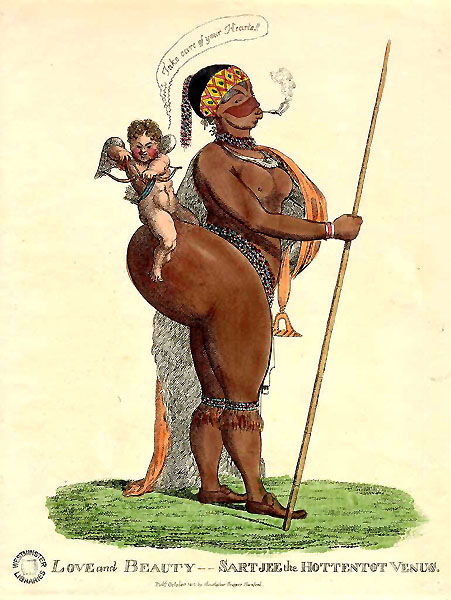
Monday night, I was very excited to present Vénus noire, the latest film by Abdellatif Kéchiche. But my excitement was tempered with trepidation. This one of those movies that I feel merits a warning at the beginning of the screening, but not for the typical reasons. It is explicit without being grotesque; it is deliberate and at the same time subtle. It is far and away the best cinematic critique of colonialism - both old and new - that I have every seen.
Saartjie Baartman, is a woman born of the Khoikhoi tribe in present-day South Africa. In 1808, Hendrick Caezar, the brother of her former master, convinced her to leave for Europe, where they might both find fame and fortune. Their method? Exhibiting Saarjtie's body in a humiliating carnival show. English anti-slavery partisans bring the act up on charges, and so Caezar, Saartjie and a new acquaintance, bear-tamer Réaux, head for Paris. Once again, the act plays in carnivals, then in the aristocratic salons of Paris, and later on among the libertines. During this time, the French anatomist and eugenistGeorges Cuvier takes an interest in her unusual anatomy (enormous buttocks and labia), but not in her mind, personality or native culture. Refusing to let the scientist fully examine her, she is effectively sold by Caezar to Réaux and finally rejected even by him to, ending up a prostitute. She dies alone of pneumonia and a venereal disease in 1815, aged only 27. Her body is returned to Cuvier and his colleagues, where is is dissected, examined, preserved and a replica displayed in the Paris Musée de l'homme until 1974.
The film is both masterful and powerful, but it's not accurate to call Vénus noire "engaging." Indeed, the source of of the movie's power resides within a tension between our (Western) expectation to be able to identify with the protagonist and Kechiche's choice to continually deny that identification. Saarjtie remains ever in shadow, ever in a cage of some kind, and always just outside our emotional reach. Even when during her monologue-like testimony at the English court-case, where she is obviously given the chance to speak for herself, we gain no clear insight into her psyche. In a less competently-constructed film, this would be a serious fault, but not so here. Kechiche uses his command of the cinematic form and his love (yes, love) for his subject to constantly transport us - he just takes us places we'd rather not go. For ours is the point of view of self-deceived Hendrick Caezar, of the unscrupulous Réaux, of the eugenist Cuvier; that is, of the Europeans that surround Saarjtie but never acknowledge her as a person. She is always nothing more than a means to an end.
The damnable thing is that these points of view are imminently sympathetic, even sometimes appealing. Caezar wants to earn enough money to return home to Cape Town and support his family. He wants Saarjtie to be an equal in their enterprise - or at least that's what he says. When at last he breaks down and physically assaults her, his motivating frustration is shockingly understandable. Even Réaux's appalling actions are tempered by an almost tender seduction scene. Georges Cuvier, too, has a sympathetic portrait. His aims are purely scientific, improving his knowledge of the human form, of our evolution and therefore, future as a living race upon this world. There's no malice to his endeavor.
But neither is there any humanity. And realizing this is the careful trap that Kechiche lays for us time and again, using our expectations - and eventually, our very hope - to lead us into blind alleys of disquiet. It is a small-voiced tragedy of tremendous proportions.
Le Petit Nicolas is a film bathed in oneiric nostalgia: a fantasy realm of France (especially Paris) during the 50's and 60's when the desperate times of Occupation and the privations of the post-war reconstruction had given over to an unparalleled economic boom full of optimism.
But this is only a dream, having only an indirect rapport with reality. If the set and costume design clearly draw from accurate historical models, if Nicolas' old-fashioned primary school and his father's impersonal workplace have real antecedents, these are all - happily - gross caricatures.
I say "happily" for two reasons. First, this is a very funny movie. The stars here aren't the actors (Valérie Lemercier and Kad Merad are big headliners in France today); neither is the director (though LaurentTirard's Molièrewas a pretty big hit); neither is the immensely popular source material. The stars here are the gags; and they're excellent. Tirard ferociously takes hold of the visual element of cinema and the situational incongruities that make great comedy to tap into everyone's love to laugh. Understanding the blitzkrieg-fast French (which can admittedly make it hard to keep up with the subtitles) adds another layer of charm and humor, but it really isn't necessary. This film is, in a way, a fabulous hypertext. But that's a subject for another time.
The film is also "happily" full of caricatures because it still has its profundities, lying just beneath its humor. There is no better satire than the world seen through the eyes of a child, whose priorities are different than those of the adults around him, whose hopeful imagination drives his actions more than his fear; whose worldview isn't entirely innocent, just different, perhaps simpler. Through the view askew, we can revel in our own memories of "simpler times" and simultaneously poke fun at adult life; that is, mock it; that is, criticize its absurd complications and torturous, sometimes unjust motivations.
The charm of this movie is Nicolas' opening invitation to take part of this view askew, to relish its joys (which aren't always that simple), to become children again without completely relinquishing an eye towards critical thinking, This is one of those films that makes you feel better, where you leave the theater with a smile on your lips. But in the car on the way home, the thought sneaks up on you: "Those absurd adults are kind of like me..."
You may have seen this video before; it's been floating about various social networks for a while now. This infographic animate was created from a speech given by Sir Ken Robinson upon his acceptance of a Benjamin Franklin Medal from the Royal Society of Arts in London. It's a fantastic dissection of what's fundamentally not working in western education today.
As an educator, this gives me certain grounds for pause. I am very much imbricated in this industrialized, machine-like system based on a twisted, out-dated version of Enlightenment ideals. But not passively. This is what I do to change the educational paradigm, one class session at a time.
Pose Questions
As I've discussed earlier, posing questions to my students is a cornerstone of my teaching technique. Some find this off-putting and even hostile, at least a first, but I also make it clear that students can pose me questions. In fact, I encourage and sometimes even require it. Class sessions are regularly punctuated with "Avez-vous des questions ?" (Do you have any questions?) and I always do my best to respond meaningfully to those questions. Some times these are "teachable moments," either a particular problem that lets the class and instructor explore a concept together or a bridge to new information.
For instance, a recent session started with the question "Que feriez-vous avec mille dollars ?" (What would you do with a $1000?). The main objective was to allow students some personalized time to express their wishes and use the conditional mood. In response to this question, one student stated they would buy an iPad with a special case. But how do you say "case" in French? There are dozens of ways, and they're pretty context-dependent. But this was a perfectly teachable moment. I opened WordReference and with the class we started sorting through the possibilities. Way down the page, eureka!
case
n
(sheath)
étui nm
Put your glasses back in their case.
Remets tes lunettes dans leur étui.
I never flinch from admitting I don't know an answer; it's always a springboard to a "Let's find out!" moment. (Or, at the very least from a "Why don't you look that up and share your findings with the class?" moment.)
More than that, one of my very first lessons with students of any level is how to pose questions in French. Class is often a chorus of Comment dit-on ...? (How do you say...?) and that's okay. I really love it when students begin asking Pourquoi? (Why?) and Mais comment...? (But how...?)
Have Fun (and Be Creative)
Critical (self-)reflection is an effective teaching tool, but all work and no play makes Noah a dull prof. Moreover, students are more than just cogitating machines; they have feelings, like anxiety and pride, and they enjoy being entertained. I work hard to have fun in class. Some times this is a simple as making an slightly off-color joke. ("Automobile traffic" in French is la circulation - like in your veins; but le trafic refers to drugs. In our lessons about cars, many student unwittingly complain about the local drug trafficking problem on campus.) Some times this is out-and-out games, like Simon Says, or Jeopardy! Mostly, I seek to create an atmosphere that encourages students to relax and therefore feel free to make mistakes.
You read that right, I want my students to screw up. Because mistakes are the beginning of learning. Every one messes up; the key is what you do next. In a positive, structured atmosphere like the one I try to create in my classrooms, mistakes are acknowledged but more so are corrections. I try to keep the former to a minimum, a cocked head (like a puppy), a half-breathed "Euh...?", a simple prompt to indicate "That's not quite right..." But corrections are praised, and loudly. I applaud; I laugh; I constantly give thumbs up.
Related to fun, creativity and personalization play an important role in my courses. The ability to express your own meaning, even simply, in a foreign language is quite an achievement. To accomplish this, I seek to find the right balance between structure (often, prompting questions) and open-ended tasks. My students interview each other a lot. (There's that posing questions thing again.) Last unit, one class wrote letters to the president of the university suggesting what kind of building we should construct next on campus; presently, I have another class writing reviews of a panoply of Francophone movies, many of which I've never seen before. Last summer, students created guided tours of Francophone destinations and crafted websites to promote them.
Which leads me to the last point:
Make Connections
For me, the pinnacle of education is the ability to make meaningful connections between people, cultures and various fields of inquiry. It's more than just getting your classmate's email address, or learning about why the French tend to have smaller cars than Americans. That's just information, trivia, just the beginning of wisdom. What I really want to see is a student create a third space that bridges the gap between two cultures. To explain to a French person why our American cars are so big and why we take them everywhere, to adapt a French poem for an American audience, to overcome misunderstanding with patience and a will towards compromise. To be more than aware, to be inquisitive, to be creative: to change the paradigm.
In the October 6 Los Angeles Times, special correspondent Kim Willsher wrote an article with the title: "France bans ketchup in cafeterias." Note the slight disclaimer in the subtitle: "Well, it's allowed with one side dish (guess which one). But putting it on veal or boeuf bourguignon is now interdit at schools nationwide."
Hilarious: those funny frogs and their stuck-up culinary ways, trying to forcefully wrench the world's most beloved dipping sauce from their children.
I'll come back to the hurtful cultural stereotypes this article employs as its hook. Let's first discuss some plain bad journalism. The new policy was implemented on October 3, 2011 to improve the health of public school lunches after more than four years of expert nutrionist research. Here are the real highlights:
A variety of 4-5 dishes must be served at both lunch and dinner
At least one of theses dishes must be a vegetable-based side and one must include dairy products
Fries (high in calories and sodium) can only be served once a week
Water and bread must be freely available, but
All sauces, including mayonnaise, vinaigrette and - yes - ketchup, are served in fixed portions directly on the student's plates and only when those sauces would be appropriate to the meal.
This policy will be enforced because schools have to document exactly what they are serving to students and report to the government. These records must be kept up to date for the previous three months.
This is a fantastic policy. France, who is simultaneously being a team-player in the European Union with this legislation, is doing hard scientific research and applying that data to better look after the health of its citizens. It's being responsible with both the content and enforcement of its legislation and shaping good eating habits in its youth. And yet, Kim Willsher decides to go with the "France Bans Ketchup!" angle?
A quick scan through Willsher's other articles for the LA Times demonstrates a competent journalist who specializes in news from Europe. The tone is even, the research is well-done and the writing is clear. So it's baffling to me how such a professional could succumb to such facile xenophobia. Let's put aside the poor translations of a few key words in the article. ("Canteen"? Really?) Maybe Willsher isn't a professional translator; but a the large proportion of articles about France, I will assume this person is at least competent in reading the language. Let's merely discuss the fact that it took me 10 minutes to Google the straight facts about this entire thing. To wit, after a digging through a "ketchup interdit" Google search, I found:
And from that article, I made a simple search for "Journal officiel", then looked within that site for the October 2 publications. Egads, I had to cross-reference a pair of one-page publications to get the skinny on ketchup and its evil cohorts mayonnaise and vinaigrette. This kind of irresponsible journalism riles me to no end. It doesn't help, of course, they this article perpetuates anti-French stereotypes, but the fact is plain and simple KETCHUP IS NOT BANNED. Fact-check; sheesh.
However, what's more pernicious here is the xenophobia that allows such an article to be published. This isn't Willsher's fault alone. Maybe Willsher thought it would be a funny fluff-piece, maybe the editor did, too. But it sticks in my craw that this last line from the LA Times article is certainly meant to be a zinger: "Food is very important here," said Hazan of the parents federation, "and we can't have children eating any old thing."
That's not funny, that's a profound statement of cultural values. It's also plain common sense: we shouldn't have children eating "any old thing." We should look after their nutritional well-being. And in France, a country with a very rich culinary heritage, it's also a matter of national pride. But Willsher and the editor and probably several people who read the article all thought that it was hilarious. Because, you know, the French are narrow-minded and denigrate anything not in line with their simplistic world-view and maniacally seek to exclude foreign products and workers and tightly control their media and economy so that it wobbles on the brink of isolationism.
Welcome (Lioret, 2009)
There's something significant about the synopsis on the DVD jacket from Netflix for this film:
When authorities forbid young Kurdish refugee Bilal (Firat Ayverdi) from crossing the English Channel to reunite with this girlfriend, the 17-year old resolves to swim to his love - and finds an unlikely ally in the form of swim instructor Simon (Vincent Lindon). Facing an inevitable divorce from his wife (Audrey Dana), the middle-aged teahcer takes the resolute youth under his wing in this stirring, beautifully acted French film.
After watching this, I can hear my graduate adviser's voice in the back of my head: "What makes this movie French, anyway?" The question maybe a poor one, but its answers are illuminating. It's a poor question because it shouldn't really matter if this film is French or not. Indeed, in many ways, it's more than that. Take a look at the the nationalities and ethnicities involved in this production: a French film with and Kurdish protagonist headed for England. Nothing like this would ever be made by an American mainstream production company. In fact, I think it would be difficult for an independent filmmaker to do. This movie is an example of a growing new trend: transnational cinema. And Welcome wears is polycentric outlook and composition on its sleeve. The polyphony of languages alone used in the film is dizzying. Its very existence is already an socially and politically engaged statement: "We are not only French, or Kurds, or Europeans; firstly, we are all people. Humans, together."
And this movie is a slow, burning indictment of the horrible things we do to each other in the name of social order and economic stability. The synopsis above is vague about just who those forbidding "authorities" are, and the movie is pretty cagey about it, too. But the clues are present, dropped casually here and there: five seconds of a Nicolas Sarkozy press conference, the understated aggressiveness as of the Calais police barge into Simon's apartment, the purely-business attitude of a lead detective investigating Simon's involvement with those in "situation irrégulière." (No one can match the French in their use of euphemism; the term means "illegal immigrant," but literally translates into "those of unusual situation, those who are unregulated," and hence, unchecked, outlaws, dangerous.)
But this kind of understatement is precisely what makes this movie French. It takes part in a long line of films à thèse whose central focus is neither narrative twists nor fancy camerawork nor spectacular special effects, but using characters as manner of sociopolitical critique. Welcome is chock full of engaging people. There's self-assured Bilal, once a soccer star in his native land, now a desperate outsider with only a whiff of a plan. Marion, Simon's ex-wife, is tender, engaged, uncertain and defiant at turns. She wants to do what's right by the hundreds of immigrants flooding Calais, but she wants what's best for Simon, which means staying out of her humanitarian work. Simon is existentially lost, hunting desperately to... do what? He's never entirely sure. Win his ex-wife back? Give his life meaning through charity? Regain a sense of masculine bravado by defying the law? Just do the right thing? Their stories, as they weave together and apart, are filmed simply, in the most unassuming manner. Save for a few travelling shots and deliberate point-of-view takes, the camera is stable, at eye level, the narrator as invisible as possible. It reminds me of something Chabrol said about his 1984 Une affaire de femmes : "C'étaient des gens simples. Il fallait les filmer simplement." (These were simple people; they needed to be filmed simply.)
Welcome does take a while to get its feet under itself. It's twenty minutes into before we even see Simon, who eventually becomes the true protagonist, and it's a solid fifty minutes before I felt properly engrossed. But Lioret's work rewards patience, and attentiveness. Taking a card from Pierre Melville's deck, scenes often jump right to the heart of the important part; there is no exposition; characters don't catch each other on what just happened. The film takes for granted that you were watching two minutes ago. I love this about French films, a quality that is so often missing in American ones.
Coupled with a clear, but never directly stated, agenda to indict the French crack down in illegal immigrants (including detention centers, police raid, tear-gassing French citizens and illegal search and seizure), this intelligence is what gives Welcome its cold burn: that slow, creeping, ironic sense of heat you get from swimming in cool water too long, from the Channel winds nipping at your exposed skin. It becomes sharp and hot, like the indignant rage you feel when a young man nearly accomplishes the nearly impossible, swimming alone across the Channel, only to drown 800 meters from shore, chased down by the coast guard.