Showing posts with label Poetry. Show all posts

Friday, April 3, 2015

scrapbook

this machine dreams that blues and whites are grey
reds become brown filtering desire through lines of code

she looked at me across the counter, a white plate in her hand
a blue stripe around the circumference of heaven

the fallen called out from the shade, through the holes
of an old coat, their song a switchblade in the wind

this reverie is more blurred than usual, but it gave me hope
light extended even into the night where my innocence wandered off

the next morning the sky was gold but the motel window gave it grit
and the power lines defied the horizon with their potential

on the bus homeward, the city’s staccato sirens giving way at last
to the highway’s hum, i found her message and anointed it with tears
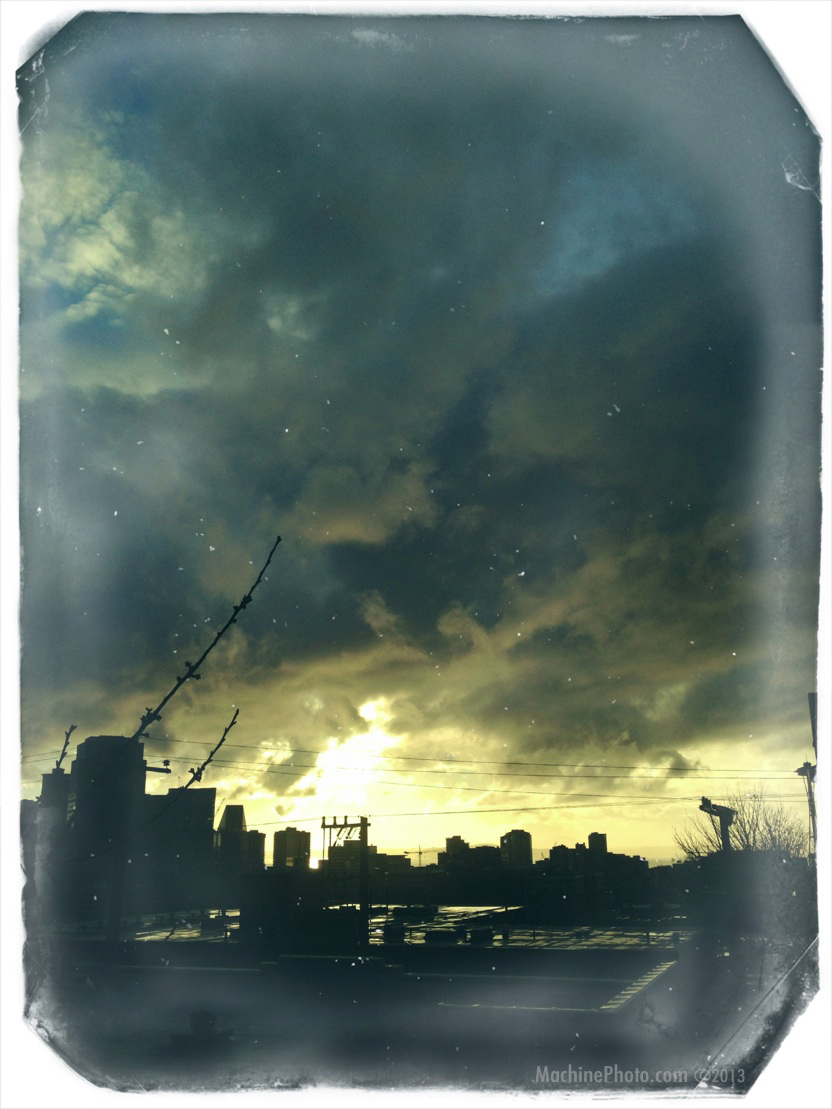
machinephoto:

The Last Sunset

Machine Dreams

tacitus

the eye of the world opened and brought with it hell
the whipping winds of the pilgrim’s descent
lovers untouching pits of tar black cities with iron gates
an icy core where escape kept you trapped feasting ravenous
a demon of despair no princes no darkness
just enough gloom to see beyond your fate
a small break in the hurricane to hear your guide whisper

this is not where we find her go further
traverse the emptiness of these souls they are not here
for penance or the miasma of iniquity they have
fallen through the ground and paid the ferryman
to enter these barrens lands of wind and shadow
because there is no light there is no sound
there is only the echo of life in their cries
their thousand lamentations but a sigh

with this wisdom, you took your first step beyond
the umbral plains towards the summit of your desire
crossed the verdancy that cast back the empty
that part only before you hands shoved forward
a heart lusting after its own ideal, dripping
with the will to do what the shadows fear
their thin chants faded with each step
and the quiet voice of the forest took up the tune

resistance

voltage, amperage, ohms, watts, dead men and stardust 
push their way through the remains of world-smashers
those vishnus of the void that once burned the air 
cigarettes of the heavens whose exhalations unfurled masses of death 
and then life upon the roiling red surface of the world

even after armageddon, the sea was red at rest
it carried stagnation and its waves could only dream of greater crests 
reaching, reaching, reaching for the moon
aspirations lunar but gravity pulling harder 
towards hot nickel and iron spinning within a gold and granite cage 

this blue sea, this new sea, covers its depths with cool serenity 
fills its widths with giant-songs that travel miles before they fade 
peoples its darkness with blind monsters lighting their own way 
without the resistance of men forcing teslas through 
circuits that cannot bear the mad genius of the universe 

and thus release light

Harmony

a swath of blasted dunes stretches the horizon
returns only a mirror of half-forgotten dreams
a beat that brings a stirring in the feet
in the lungs of the traveler before the road that was
before the awful emptiness that longs to be filled
the rhythm that may overwhelm its potential
wind dips and croons a missing melody just over the next rise
just beyond the next turn the future whispers
across the barrens where pale bones lay exposed
they augur missed steps beyond counting
centuries of treble clefs and accidentals
leading to one final phrase of joy and sorrow all at once

Wednesday, July 4, 2012

stone-patient & river-flow

http://infogirl.org/

new ink, old lines that sprawl and wind
tributaries of runes calligraphed by half-understood
so doubly-felt pulses of more than blood

the electricity you draw aches and arcs
in waves to make Tesla proud with that smile
at once hubris and hidden

i want to reach through the plasma frames
past the simple dyads and kiss you
in the hot shadows of your bed

it's a fair piece and long time coming
but i am stone-patient wrapped around
a river's serpentine swing

never stopping, ever crooked
breaching my banks, a mad torrent forward
toward the sea of you

Saturday, June 9, 2012

must

flickr.com/photos/andrewreason

my love is a flower pressed between her sorrow and the pages
she pens to keep unbound until the morrow for sun must rise
stars must sigh charcoal twilight giving way to azure

my soul is a whisper passed along lips of secret lovers
strangers of the witching hour whose sheets fold origami passion
salty lips uncover discover recover hands that must caress
eyes that must rest upon a warm skin that should not be seen
let alone touched tasted consumed

my dream is a traitor lost along the road to Judea
long miles i have let slip between us while tracing small steps
the angel's tread of souls more blindly wise than me
for hearts must believe must feel that they pump and push and pull
our tongues entwined pressing between them this unbearable cry
the petals of a blossom tucked away in the oubliette of her Alexandria

Monday, May 28, 2012

Soul Clap Its Hands and Sing: "it was a pleasure to burn" production diary

Today's offering features special guest Shanna Germain. I discovered Shanna's This Body of Work on Google Plus, and instantly fell in amazed lust with her often sexually-charged and always in-charge short work. In mid-January, she posted "Soul Clap Its Hands and Sing," and I thought "I can totally use this for FAWM material!" It never happened during the month of February, but in early March I had a track ready. Problem was, it used my low, growling baritone, which didn't quite fit with the clearly feminine point of view. So, after long weeks of gentle nudging, I got the artist herself to give me a track.


I.
The trouble is the ship left without me. Also I cut a hole
in the sunset-tinged sail. Not a hole; a heart shape.
I almost forget they’re the same. The scissors sank like
live weights, flashing their teeth at the mackerels.
Summer ends with a settle of silver and sand.

II.
A woman alone is an alien thing. The dock rejects her heft.
Mouths open to the sky, golden birds pray for rains
and the wormtails of truths. Wishes can break your neck
if you don’t cant your face three degrees to the right.
of the mast. Look at me, quick. There’s nowhere else to go

III.
but down. Last night the boatman had tomorrow for eyes.
There was no place left to slot my coins. Think of that face
like the ones drawn on rice—a curio to scare the children with.
My muse slunk off with a half-cocked heel and a man
half her age. If I believed in gods, I’d fuck them all.

IV.
Once I was younger. Every word was a seaweed scrawl of bracken,
every line a breaking wave of wood. Who wants to be a bird
when I can be me? Song was never mine for pyre. My hair is spun
of golden scales. When the ship sinks, let’s say it was never my fault.
Let’s say I really wanted to go all the way.
I feel like I should tell you more about Shanna, but I also feel that I don't really have the right to pin her down like that. Besides, she's done a very good job of it herself:
First and foremost, she is a leximaven of the highest order, exploring her love of the written word through a multitude of formats and styles. Shanna (pronounced like ‘Shaun’ with a sigh of pleasure at the end) also claims the titles of (in no particular order):  girl geek, lust/slut, wanderlust-er, avid walker and biker, tree kisser, knife licker, steak-maker, book-nerd and Schrodinger’s Brat.
With a whole lot of writing years under her belt (or her collar, depending on the day), Shanna’s poems, essays, short stories, novellas, articles and more have found homes in hundreds of magazines, newspapers, books and websites.
I have long been a fan of spoken word pieces, that peculiar subgenre/step-chield of audio books and songs. But they can be tricky things; it's not a mere matter of recording a poetry recitation (which this offering led me to discover is no "mere" matter.) A spoken word piece is about ambiance, closer to Ani Difranco's ethereal jazz riffs or the wonderful weirdness of Coil.

For this composition, I went to my favorite sample junkyard: SampleSwap. Every last bit of percussion that you hear is from there; about three or four different pieces, with varying amounts of reverb and other effects. With the right groove underway, the rest of the composition feel easily into place. There's no chorus or any kind of refrain, but I knew that I wanted to somehow subtly translate the numbering of the stanzas in Shanna's poem. Thus, those pounding guitar breaks. (Over which, inevitably, I couldn't resist re-sampling some vocal parts; so, now there is a refrain.)

Musically, "Soul Clap" is all about dynamics, moving from that heart-beat thrum to a tinkling acoustic to the pounding distortion of the refrain guitars, and then back again. It's also about theme and variation, as each verse features the chord progression and mini-melody in a slightly different way. That wonderful whine throughout, by the way, is a MIDI-cello with a heap of effects on it.

I am very grateful for Shanna agreeing to do the vocals. I love to collaborate, especially with women who lend my work a much need variance in tone.

This week, real life and its real job rear their heads again, so I'm not sure what I'll be able to do in the studio. Have no fear, however, more to come!

Monday, November 14, 2011

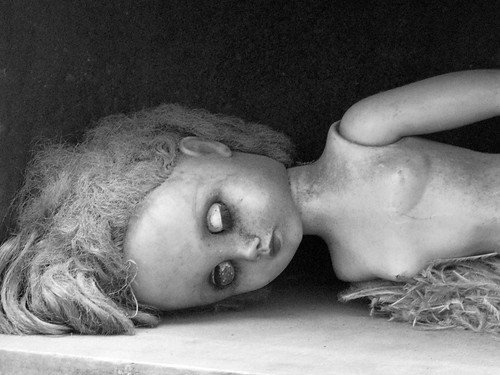
broken doll

Capo 2 [D - Am - C - G]
i am letting too much slip away
seems there's nothing left to hang on
just a voice on a distant phone
echoes of things pretending to be

she is your mirror; she is your twin
it's still not you; still not the same
there's a hole where your aura used to shine
spots on the sun where love would climb

[F - C :| F - C - G - G]
how do you do it?
i want to know
this broken doll i take home
how do you do it?
you want to know?
this broken soul you make whole

the stage was small; the billing, too
it was still the show to end all shows
you take your coffee black but a little sweet
these things stick with me even still

like morning traffic through a dirty pane
waking you from nightmare dreams
like letting go while i kicked and screamed
but only in my head

how do you do it?
i want to know
this broken doll i take home
how do you do it?
you want to know?
this broken soul you make whole

deep in that forest of steel and stone
we fought our dragons and we lost
we took on casualties and bound their wounds
we never took notice of our own

lamb or lion, it's all the same
i was your lullaby; you were my flame
i've been chasing shadows ever since
you have long been hunting this

i've been chasing shadows ever since
you have long been hunting this

Friday, October 21, 2011

What is a song?

It's time for an exercise in synchronicity, collage and reflection. All in the search of a response to a pretty contentious question: what is a song?
Synchronicity
Yesterday afternoon, I was taking some personal time to stroll through my Google Reader account. I've got all sorts of stuff that I follow there, everyone from film critic MaryAnn Johanson to SkepChick to Maurissa Tancharoen Whedon and a bushel of online comics from xkcd to Order of the Stick. Long story short (too late!), I get a regular deluge of engaging and occasionally off-beat stuff.

To wit: on Songwriting Scene, there's a link to a 2000 Suzanne Vega interview with songwriter Jack Hardy. While Sharon Goldman, author of Songwriting Scene, wants to focus upon the false dichotomy of songs vs. poetry, the interview explores many more issues about contemporary, traditional and even ancient songwriting. I read Goldman's post, and shrugged a bit because I agree with Hardy that songs and poetry have more in common than they have differences.

But, with that article still fresh in my mind, I immediately went to Flick Filosopher and found the video below, called "Prisencolinensinainciusol" from a 1970's Italian TV show. It's a deliriously fun four-minute slice of disco-flavored big band beats and some really impressive set design and collective choreography:


But, the entire time I was watching it, I kept having this niggling feeling of both lack and doubt. Lack, because, despite the really engaging music and the fact that words are in English, the lyrics are utter gibberish. Doubt - that this was indeed a song. It reminded me of a polite disagreement I had with a fellow SongFighter, Kapitano, about his submission to the "Circle Me" fight back in July.

The lyrics' "language" is entirely made-up, though based upon real-world tongues. The first verse goes :
udu mbu adu (muza zimba)
uwa ungi iba (mudu ngu)
ngu ndu uzi (hawa yami)
wadinga wa ma (buwamu mbu)
I contend that neither of these compositions are songs. But that's easier to say than to argue convincingly, so let's start gathering some ideas.

Collage, part 1: What a song isn't
Wikipedia's "song" entry is pretty thin and seems to come down firmly on the fence. Besides, the more I thought about this idea, the more I wanted a more authoritative source of background information. When in doubt about the meaning of a word, the Oxford English Dictionary is my best tool. So, what is the OED definition of a song?
song1. The act or art of singing; the result or effect of this, vocal music; that which is sung (in general or collective sense); occas., poetry.2. a. A metrical composition adapted for singing, esp. one in rime and having a regular verse-form; occas., a poem.
So far, both "Prisencolinensinainciusol" and Kapitano's "Circle Me" still qualify as a song. They are sung and are metrical compositions adapted just for that purpose. They both have rhyme and verse form. However, this is where the Vega/Hardy interview comes into play along with the ending phrase of each OED entry. Hardy is adamant that "songwriting is poetry;" he points out that poetry was sung for millennia. The modern shift towards poetry as we know it (often free verse and/or concrete, intended as much to be read and seen on the page as to be recited) is very recent and has created a false division between two arts that are sympatico.

So, what is poetry? Back to the OED!
poetry II. (in existing use) 3. The art or work of the poet. a. With special reference to its form: Composition in verse or metrical language, or in some equivalent patterned arrangement of language; usually also with choice of elevated words and figurative uses, and option of a syntactical order, differing more or less from those of ordinary speech or prose writing. In this sense, poetry in its simplest or lowest form has been identified with versification or verse. [my emphasis].
I particular like the final entry in II.3, providing a clear and useful distinction between poetry and prose, which John William Mackail identifies as "the repeat":
1906 J. W. Mackail (Communicated), In general, the essence of poetry as an art is not so much that it is rhythmical (which all elevated language is), or that it is metrical (which not all poetry is, except by a considerable extension of the meaning of the word), as that it is patterned language. This is its specific quality as a 'fine art'. The essence of 'pattern' (in its technical use, as applied to the arts) as distinct from 'composition' generally, is that it is composition which has what is technically called a `repeat'; and it is the 'repeat' which technically differentiates poetry from non-poetry, both being (as arts) 'composition'. The 'repeat' may be obvious, as in the case of rhymed lines of equal length, or it may be more implicit, to any degree of subtlety; but if it does not exist, there is technically no poetry. The artistic power of the pattern-designer is shown in the way he deals with the problem of 'repeat'; and this is true of poetry likewise, and is probably the key (so far as one exists) to any technical definition or discussion of the art.
Still, if repetition is the key to poetry and poetry is a synonym for songwriting, this is doesn't solve my dilemma. "Prisencolinensinainciusol" and Kapitano's "Circle Me" both rely on repetition in many ways, including rhyme, assonance and consonance. But note that Mackail says "patterned language" and while he places an emphasis on "patterned," I'd like to take a closer look at "language."
language
2.a. In generalized sense: Words and the methods of combining them for the expression of thought.
Eureka! "For the expression of thought," this is precisely what these two compositions are lacking. They express emotion, but there's no message, no narrative, no meaning in their lyrics, merely the abstract use of vocals in the same way as any other instrument. In certain respects, the vocal melody could have been carried by a guitar, or a violin, or a Jew's Harp with the same effect. (Though I do admit, with respect to the precise tonality and timbre of the human voice, the choice of "instrument" does make a difference, sonically but not semiotically.)


Collage, part 2: What a song is
Reductive arguments are a rather poor way to craft a definition (and all definitions are arguments). If these two compositions are not songs because they don't use language, what is a song? I think Vega's and Hardy conversation holds some key points that ring true for me. In brief, songs - good songs, at least - are narrative and dialogic.

Jack Hardy states "I think that every song is potentially almost like a play." Even at their most abstract, songs tell stories, they delve deep into our Jungian subconscious and connect with some of the basic drives; they animate the most primal of archetypes. This is their power. Hardy elaborates:
JH: If you take the song as... Like when you're telling a child a bedtime story, they're not listening to you tell a story. They're in that story. They become the princess. Everything that's happening to the princess is happening to them. And to me, a song, when it's good, does that same thing, places the listener in the song. Because when you move the listener physically into the song, their emotions follow. 
This idea leads to the dialogic characteristic of songs and poetry, that is, their equally performative and interpersonal nature. Vega poses the question, "Do you ever think about how it will be perceived by your audience?" and Hardy eventually responds, "Oh yeah. I feel that a song is a two-way street." More importantly, "poetry or song should be accessible to a more general audience and shouldn't be exclusionary." Language is precisely what allows a song to be inclusive. This seems to be an essential point for Hardy, who has rather long diatribes in the interview against the increasingly egocentric and form-fascinating modern trends in both poetry and songwriting; so, language itself isn't sufficient. But it is necessary; Hardy continues his "princess" metaphor in this vein: 
Because when you move the listener physically into the song, their emotions follow. As long as they're still stuck in their cerebral self, you don't have their emotions; they're still thinking about it. They might think that this is a good song, but you're still in the ego level of "this is good/bad"; you don't really have their emotions.
If language is the point of entry, as I contend it is, then this is precisely what happens to me when I'm listening to songs with nonsense lyrics. I'm always thinking about it; I'm not feeling it. And this is somewhat ironic, because they're probably designed to be "feel-pieces," instead of "think-pieces," more akin to Bach's Toccata and Fugue in D minor ...
... than to, say, even something as lyrically abstract as DJ Ranger Den's tone poem "Shoot Through It."

But because they're offered as "songs" and not "compositions," there is a generic disconnect. I keep waiting for a story, for meaning, for thought. In fact, I'll even start trying to construct something even where's there's no there there.


Reflection: How does a song come to be?
I've whittled out a pretty solid definition here, I think. A song is a metrical composition adapted for singing, an artistic form similar to poetry and whose lyrical element contains language.

But we've come to the "so what?" part of our ruminations. In the definition above, a simple ditty like "Ring Around the Rosy" would qualify as a song while the musical engaging and even complex "Prisencolinensinainciusol" does not. Even if we set aside any issues that such a labeling might be qualitative and/or comparative, of what use is this definition?


Well, for me, at least, this definition helps to resolve that nagging feeling that I got listening to Kapitano's "Circle Me" and the "Prisencolinensinainciusol." Maybe, for you, it might serve some other purpose. Good try it out, and let me know what shakes loose.


Friday, October 14, 2011

Siren Sleek & Faster Fury

Stolen soaring siren star
Variable in her variant orbit
The system is binary we circle differently
Trajectories at odd angles crossing
At points only ever uncertain
Any plans to the contrary are best laid
Like those of mice and men playing Einstein's dice
It was it is it will be must be unforeseeable
Stolen soaring siren star

Fueling funneling faster forward
Outpace outstrip outsmart the lacuna
Which is not so much a lack
As a burning void an ellipse orbiting darkness
That I might use as a rocket takes up hydrogen
Ignites it directs it spews it forth
White hot no color no love no living thing
But distance ever growing ever stretching
Further fleeing the darkness behind
Fueling funneling faster forward